

Guide · Updated September 2026
VOC vs formaldehyde: what's the difference?
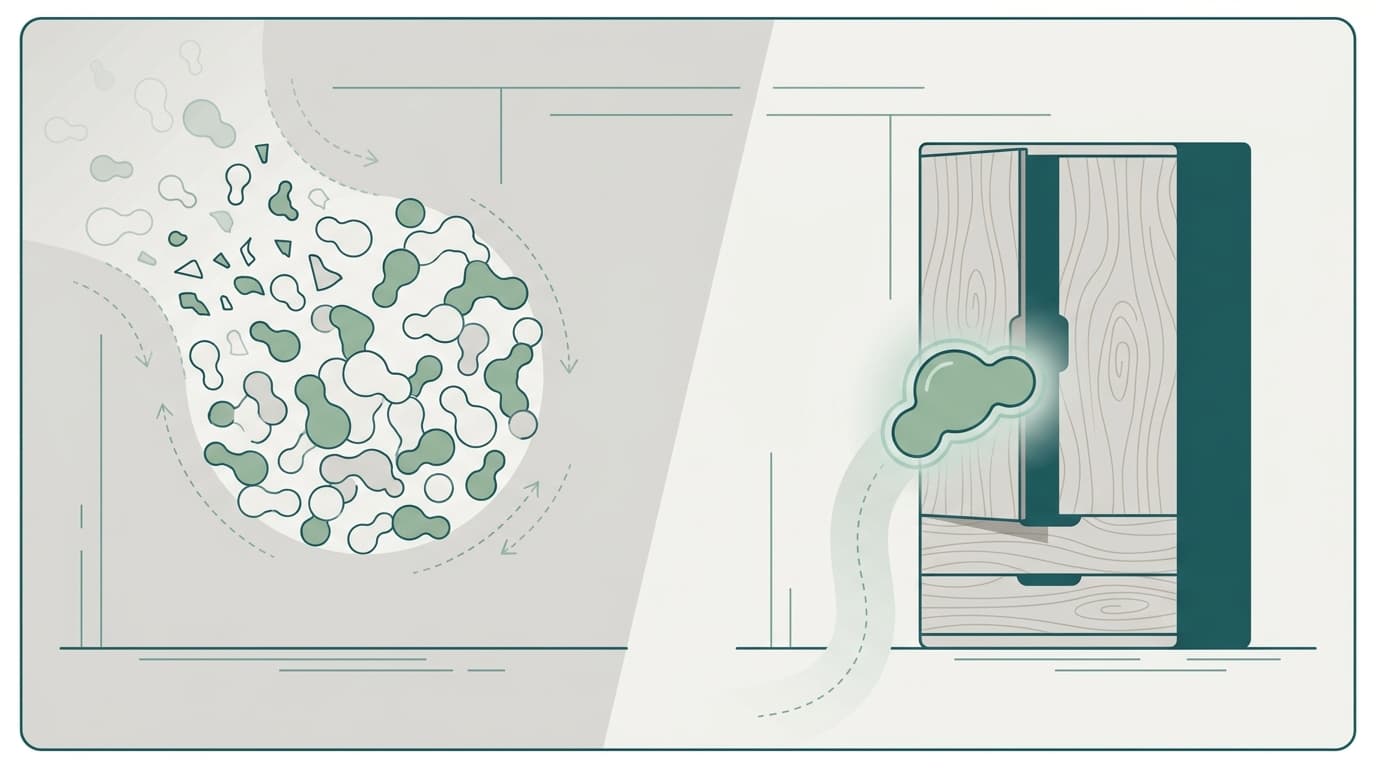
Formaldehyde is a VOC — the confusion comes from marketing that treats them as two separate problems. The difference that actually matters is behaviour: most renovation VOCs evaporate from applied coatings and clear within weeks, while formaldehyde is continuously generated inside the resins of composite-wood carpentry for years. The two therefore need different responses — one mostly needs time and ventilation, the other needs source treatment.
What VOCs are
VOC stands for volatile organic compound — a broad family of carbon-based chemicals that evaporate readily at room temperature. A fresh renovation releases dozens of them at once: toluene and xylene from paints, solvents from adhesives and sealants, and even limonene from the citrus-scented cleaners used at handover. Together they make up most of that sharp "new reno" smell.
Air-quality meters usually report these as a single TVOC (total VOC) number. Treat that figure as a trend indicator, not a health benchmark: it lumps harmless and harmful compounds into one aggregate, and there is no single TVOC standard to judge it against. A falling TVOC over days tells you the paint and solvent phase is passing — it says nothing specific about formaldehyde.
Formaldehyde vs typical renovation VOCs
| Formaldehyde | Typical renovation VOCs | |
|---|---|---|
| Source | Generated inside urea-formaldehyde resins in plywood, MDF, particleboard | Applied coatings — paints, adhesives, sealants, cleaners |
| Release period | Years (the resin keeps breaking down) | Days to weeks (a finite layer evaporates) |
| Smell | Faint; pungent only at high levels — a poor warning signal | Strong solvent smell, obvious while it lasts |
| Fix | Source treatment of the carpentry | Ventilation and time |
| Guideline | WHO indoor guideline: 0.1 mg/m³ | No single TVOC standard |
What this means for treatment
Because ordinary VOCs dissipate on their own, a "VOC removal" package bought in the first weeks after renovation is largely riding on natural dissipation — the air would have cleared on a similar timeline anyway. Formaldehyde is the exception: its source is sealed inside your carpentry and keeps producing gas long after the solvent smell is gone, which is why it needs source treatment rather than waiting.
- Just painted, no new carpentry? Ventilate and wait — the smell is solvent VOCs and it will pass in weeks.
- New built-ins, wardrobes or MDF furniture? Test, and treat if readings are elevated — time alone works on the scale of years, not weeks.
For the fuller timeline of what off-gasses when, see new renovation smell: what off-gasses and for how long.
A note on "VOC-free" and E0/E1 board labels
Lower-emission boards are genuinely better: E1 and E0 grades cap how much formaldehyde a board may emit, and choosing them at renovation time is worth doing. But "low" is not "zero" — the labels limit emission per board, and a home fully lined with E1 carpentry can still sum above the WHO guideline once doors and windows are closed. The label is a starting point; the reading is the answer. See safe formaldehyde levels for what the numbers mean.
Not sure which problem your home has?
A S$100 testing visit gives you room-by-room formaldehyde readings — so you wait, ventilate or treat based on numbers, not smell.