
Guide · Updated October 2026
Does your aircon remove formaldehyde?
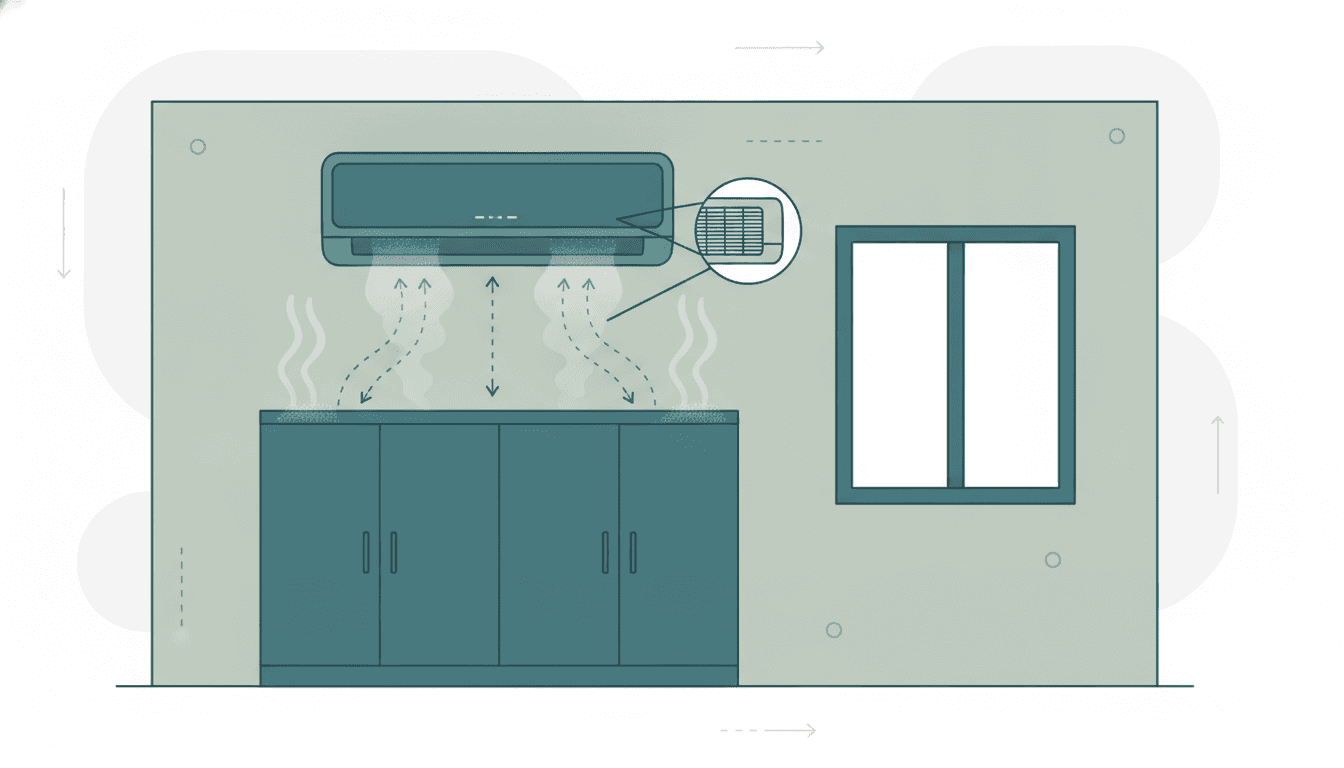
No — and it can make the problem feel worse. An air conditioner cools air by recirculating it, not by replacing it with outdoor air. Formaldehyde is a gas, so it passes straight through the dust filters and even through a HEPA filter. Worse, the wet cooling coil inside the indoor unit can hold onto the formaldehyde and other VOCs that pass over it, then release them back into the room when you switch the unit on. If your home smells sharper — or your eyes and nose sting — in the first minutes after the aircon starts, this is usually why.
None of that means the aircon is the source. The source is your carpentry. But understanding the aircon's role explains a symptom that confuses a lot of people after a renovation, and it changes the order in which you should fix things.
Cooling is not ventilation
This is the single most common misunderstanding about indoor air in Singapore.
A standard split-type air conditioner — the wall-mounted unit in almost every HDB flat and condo — has no fresh-air intake. It draws room air in at the top, passes it over a cold coil, and blows the same air back out colder and drier. The outdoor unit exchanges heat, not air. Over an eight-hour night in a closed bedroom, essentially the same air circulates through the unit hundreds of times.
Formaldehyde released by your wardrobe, bed frame and feature wall during those eight hours has nowhere to go. Running the aircon does not dilute it. Opening a window does.
| What it does | Effect on formaldehyde | |
|---|---|---|
| Air conditioner | Recirculates and cools indoor air | Effectively none; can re-release stored VOCs |
| HEPA filter | Traps airborne particles | None — formaldehyde is a gas, not a particle |
| Activated carbon filter | Adsorbs gases onto carbon | Some, if the carbon mass is substantial and replaced |
| Open window / fan | Replaces indoor air with outdoor air | The most reliable everyday reduction |
| Source treatment | Reacts with resin surfaces to cut emission | Addresses the cause rather than the symptom |
Why the smell comes back when you switch on
Formaldehyde is unusual among renovation VOCs in one respect: it is extremely soluble in water. That matters because of what a cooling coil actually is.
When the unit runs, the coil sits well below room temperature and pulls moisture out of humid Singapore air — that is the water you see draining out of the pipe outside. Formaldehyde passing over that wet, cold surface dissolves readily into the water film. At the same time, the layer of dust, grime and biofilm that builds up on the coil and blower wheel acts as a sponge for VOCs generally. Indoor-air researchers call this the sink effect, and air-conditioning surfaces are among the more significant sinks in a home.
Then you switch the unit off. The coil warms up, the water film dries, and the loaded surfaces slowly give back what they absorbed. When the aircon starts again, the first minutes of airflow carry a concentrated pulse of it into the room — right at the moment you have just walked in and are most likely to notice.
Two honest qualifications:
- A clean, freely draining unit does the opposite, slightly. Dissolved formaldehyde that leaves through the drain pipe is genuinely removed from your air. The reservoir problem belongs to units with a heavy dust and grime layer — the ones that have not been serviced in a long time.
- This is a symptom amplifier, not the cause. Even a spotless aircon in a freshly renovated flat will not fix elevated formaldehyde, because the carpentry keeps producing it.
The temperature paradox
Air conditioning genuinely helps in one way, and it is the opposite of what most people assume. Formaldehyde emission from plywood, MDF and particleboard rises with both temperature and humidity: the urea-formaldehyde resin holding those boards together breaks down faster when it is hot and damp. A sealed flat at 33°C on a Singapore afternoon is close to a worst case; the same flat at 24°C and lower humidity releases meaningfully less.
So air conditioning slows the release while trapping what is released. Both are true at once, and the practical resolution is not to choose between them: cool the room, but ventilate it too. Air the room out properly before you close it up for the night, and do not treat a cool, closed room as a clean one.
If the aircon is holding VOCs, does cleaning it help?
Yes — but only for the part of the problem that lives inside the unit.
A chemical wash strips the accumulated grime, biofilm and dust from the cooling coil, blower wheel and drainage tray. Removing that material removes the sink: the unit stops storing and re-releasing VOCs, and it also clears the mould and bacteria behind the separate musty smell that many people mistake for a chemical one. If the unit is dirty, it is worth doing on its own merits.
Prevention is cheaper than the wash. A unit that gets regular general servicing — filters washed, coil and blower cleaned, drain line flushed every few months — never builds up the grime layer that turns it into a reservoir in the first place. If you are moving into a renovated home, book the servicing for after the dusty works are finished, not before: renovation dust is exactly what clogs the coil.
Recommended companies for this work:
- Cool Aircon — chemical wash, for a unit that has gone a long time without cleaningBlk 153 Bukit Batok Street 11, #03-290, Singapore 650153 · +65 9778 8986
- LM Brothers Aircond Pte Ltd — general servicing, to keep the coil clean between washes21 Woodlands Close, #07-45 Primz Bizhub, Singapore 737854 · +65 8193 8336
What neither does is reduce the formaldehyde coming out of your carpentry. Anyone who tells you that servicing your aircon solves a formaldehyde problem is either confused or selling you the wrong thing. The order that actually works is below.
What actually works, in order
- Ventilate, deliberately and daily. Cross-ventilation — windows open on opposite sides with a fan pushing air out — for as long as you can manage. It is free and it is the single most effective thing most households can do.
- Deal with the source. Emissions come from composite-wood carpentry and continue for years, not weeks. Where you still have choices, lower-emission boards help. Where the carpentry is already installed, professional source treatment is what reduces emission at the origin.
- Test before you assume. Smell is unreliable in both directions, so neither its presence nor its absence tells you where you stand. A calibrated reading against the WHO guideline of 0.1 mg/m³ does — see safe formaldehyde levels.
- Clean the aircon if it is dirty. Removes the reservoir and the musty-smell problem. Do it after or alongside the above, not instead of them.
- Use activated carbon if you want a supplementary measure. Look for units with a real weight of carbon and replace the cartridge on schedule — a saturated filter stops working. The thin black mesh sold as a "deodorising filter" inside an aircon is not this. More in do air purifiers remove formaldehyde.
Smell, irritation, and what each tells you
People generally arrive at this topic because of a symptom, so it is worth separating the signals.
| What you notice | Most likely explanation | Where to start |
|---|---|---|
| Sharp, pungent smell; eyes, nose or throat sting | Elevated VOCs including formaldehyde | Ventilate now, then test |
| Musty or sour smell, strongest in the first minutes | Mould and bacteria inside the aircon | Aircon servicing or chemical wash |
| Smell noticeably worse when the aircon starts | Sink effect in a dirty unit, over a VOC baseline | Test, and clean the unit |
| No smell at all, recent renovation | Tells you very little | Test if anyone vulnerable lives there |
Irritation is the more specific signal. Formaldehyde is a sensory irritant, and stinging eyes or a scratchy throat that improves when you leave the flat and returns when you come back is a pattern worth acting on. Odour on its own is unreliable: your nose fatigues within minutes of entering a room, and individual odour thresholds vary so widely that some people smell nothing at levels already above the guideline. More on this in formaldehyde symptoms.
Babies, and why the nursery is the worst room
Infants have a higher breathing rate per kilogram of body weight than adults. They spend far more hours asleep, usually in one room, usually with the door closed and the aircon running. And a nursery is very often the newest room in the flat — new cot, new wardrobe, new feature wall, all installed weeks before the baby arrives. Every factor stacks in the same direction: the highest-exposure room in the home is frequently the one with the youngest occupant.
Formaldehyde is classified as a Group 1 carcinogen by the IARC, and exposure has been linked to airway irritation and asthma symptoms in children. That is a reason for care, not alarm:
- Let new furniture off-gas before the room is occupied, ideally unwrapped in a ventilated space rather than sealed in the room it will live in.
- Ventilate the nursery daily, and air it out before closing it up for the night.
- Service the aircon before the baby moves in, so the unit is not holding a reservoir of anything.
- If the renovation is recent, test rather than guess. This is the one room where a number is worth having.
More in formaldehyde, babies and pregnancy.
Common questions
Does running the aircon on "dry" or "fan" mode remove formaldehyde?
No. Dry mode dehumidifies and fan mode simply circulates air — neither brings in outdoor air, and neither removes a gas. Dry mode may slightly reduce the humidity that drives off-gassing, but the effect is marginal next to opening a window.
Will an air purifier in the bedroom fix it?
Only partially, and only the right kind. Particle filters, including HEPA, do nothing for formaldehyde. Activated carbon adsorbs it, but capacity is finite and depends on how much carbon is in the unit — a small cartridge in a large bedroom saturates quickly. Treat it as a supplement to ventilation and source treatment, not a replacement.
My aircon was just serviced and the smell is still there. Why?
Because the aircon was never the source. Servicing removes what the unit was holding; it does not touch the carpentry that keeps producing formaldehyde. If the smell or irritation persists with a clean unit and good ventilation, that is the point to test.
Is it safe to sleep in an air-conditioned room after a renovation?
For most healthy adults the practical answer is to ventilate thoroughly first, then run the aircon, rather than sealing an untreated room. If the renovation is very recent, or an infant, pregnant occupant or someone with asthma sleeps there, get a reading before relying on judgement.
Does the aircon spread formaldehyde to other rooms?
A single split unit serves one room, so no. What moves formaldehyde around a flat is ordinary air movement between rooms — which is also why treating one room and sealing the rest is not a complete answer.
Clean aircon, still stinging eyes?
Then the aircon was never the source. A S$100 testing visit gives you room-by-room readings against the WHO guideline, and the fee is waived if you go ahead with removal.