
Guide · Updated July 2026
Formaldehyde removal sprays: do they actually work?
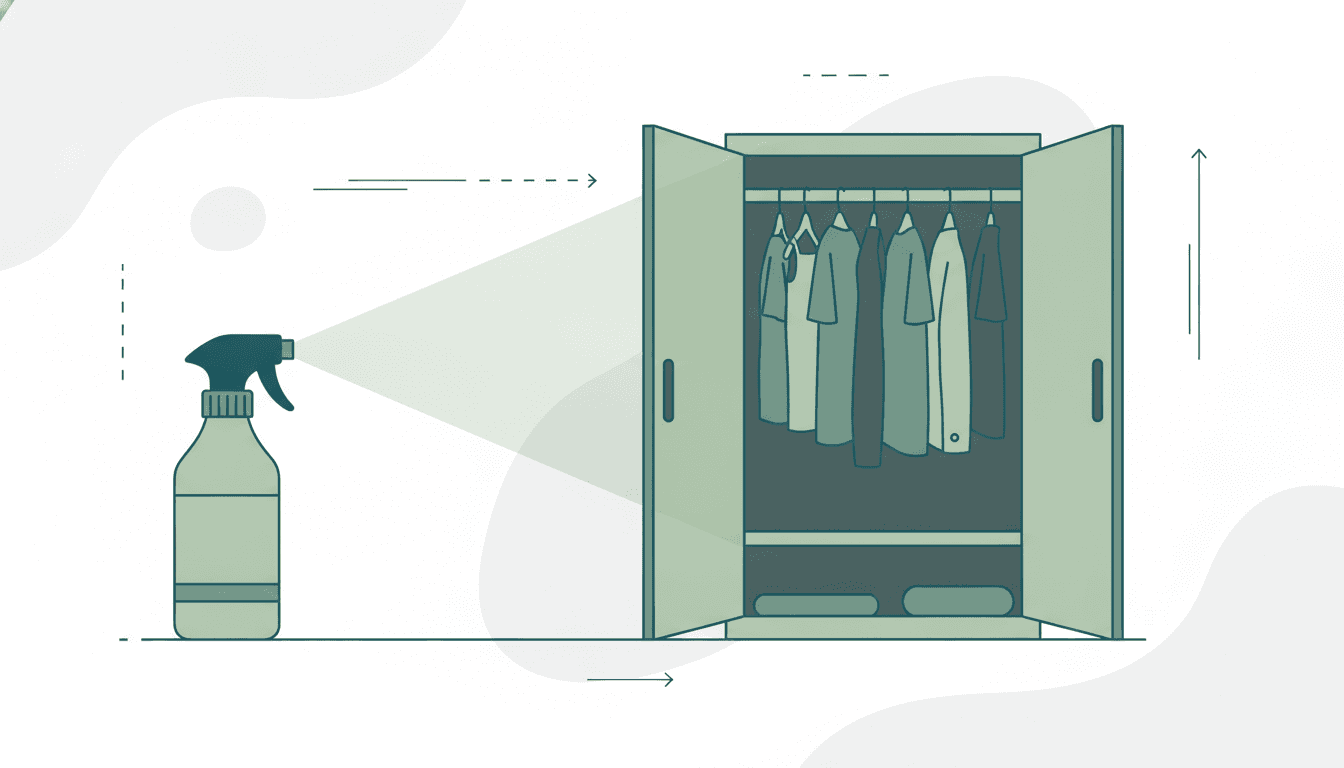
The chemistry in a consumer formaldehyde spray is usually real. The problem is almost never the bottle — it is where the mist lands. Most of the formaldehyde in a renovated home comes from enclosed surfaces that a hand spray never reaches, and the one thing that would tell you whether the product worked — a meter reading — is exactly what a DIY bottle does not come with. That does not make sprays useless. It makes them useful in a much narrower set of situations than the label suggests.
What is actually in the bottle
Retail sprays in Singapore fall into four families. Knowing which you are holding explains most of what it can and cannot do.
| Type | How it works | Main limitation |
|---|---|---|
| Photocatalytic (TiO₂) | A titanium dioxide coating that breaks down formaldehyde on contact when activated by light | Needs UV or strong visible light — inert inside a closed wardrobe |
| Scavengers / capture agents | Amino- or urea-based compounds that bind formaldehyde into a stable, non-volatile molecule | Finite capacity — the coating saturates and stops working |
| Oxidisers | Chlorine dioxide and similar agents that oxidise formaldehyde in air and on surfaces | Short-lived, can bleach or corrode, unsuitable for continuous use |
| Plant-extract "enzyme" sprays | Marketed as natural decomposition; composition often undisclosed | Weakest evidence of the four; some are principally fragrance, which masks rather than removes |
The coverage problem
Formaldehyde is not sitting on your furniture like dust. It is generated continuously inside the resin that bonds the board, and it escapes fastest wherever board is unsealed and air is still:
- The inside faces and back panels of wardrobes, kept shut for most of the day
- Unsealed board edges, drawer backs and the undersides of shelves
- The cavity behind kitchen carcasses and the void above top carriers
- Bed frame slats and the enclosed space under a storage bed
A person with a spray bottle treats visible, reachable surfaces — which are the surfaces already emitting into open, ventilated space and clearing fastest on their own. The enclosed points doing most of the work go untreated. That is why a spray can genuinely reduce emission from a single sideboard and still barely move a whole-home reading.
The light problem, specifically
This one deserves calling out because it is the most-marketed and least-understood mechanism. Standard titanium dioxide photocatalysts are activated by ultraviolet light; visible-light formulations exist but still need meaningful illumination. Applied to a wardrobe interior, a drawer back or the cavity behind a carrier — the places emission is highest — a plain photocatalytic coating sits inert. Sprayed onto a sunlit tabletop, it works as advertised on a surface that was not your problem.
When a spray is genuinely the right call
There are real cases for a S$20–60 bottle, and it is worth being straight about them:
- A single new item — one wardrobe, one bed frame, one sideboard that smells strongly while the rest of the home is fine.
- Readings already close to the guideline — a small nudge is all that is needed, and you have a meter to confirm it.
- Rental or short tenancy — where paying for treatment of a home you will leave is hard to justify.
- Alongside ventilation, not instead of it — for the first weeks after handover, airflow does more than any product.
The case it does not cover is the common one: a freshly renovated flat full of new built-ins, with a move-in date and a child, reading well above guideline throughout.
If you are going to use one, use it properly
- Empty the furniture first and spray interiors, backs and edges — not just the doors.
- Test on a hidden patch. Water-based products can swell unsealed MDF edges and dull some laminates.
- Ventilate hard during and after application; most of the benefit in week one is the open windows, not the bottle.
- Expect to reapply. Scavenger coatings saturate, and a renovated home keeps emitting for years.
- Measure before and after if you can. Note that cheap handheld meters have their own accuracy problems — see formaldehyde detectors and meters.
How professional treatment differs
The honest distinction is not "stronger chemicals", though concentration does differ. It is coverage and verification: technicians open and treat the enclosed emission points a homeowner cannot easily reach, use agents that do not depend on ambient light, and then measure every room against the WHO and SS 554 guideline of 0.1 mg/m³ before leaving. A whole home takes 2–4 hours and starts at S$420 at published fixed prices; the chemistry and the re-treat guarantee are set out on the service page.
For how sprays rank against every other option — ventilation, bake-out, purifiers, plants — see how to remove formaldehyde.
Common questions
Do formaldehyde removal sprays actually work?
The chemistry in them is real, but the coverage usually is not. A hand-misted spray treats the outer surface it lands on, while most emission comes from enclosed areas a mist never reaches — wardrobe interiors, drawer backs, unsealed board edges and the undersides of shelving. On a single piece of furniture a spray can measurably help. Across a whole renovated home it rarely brings readings below the WHO 0.1 mg/m3 guideline on its own.
Are photocatalyst sprays sold to consumers the same as professional ones?
They share a mechanism but differ in concentration, particle dispersion and how they are applied. The larger practical gap is light: standard titanium dioxide photocatalysts need ultraviolet or strong visible light to activate, and the inside of a closed wardrobe has neither. Professional application targets those enclosed emission points directly and pairs the coating with agents that do not depend on light.
Can a formaldehyde spray damage my furniture?
Some can. Water-based sprays applied heavily to unsealed MDF or particleboard edges can swell the board, and a few products leave a visible film or dull matte laminate and mirror finishes. Test on a hidden area first, keep application light on unsealed edges, and never spray electronics or leather without checking the label.
How will I know whether the spray worked?
Only by measuring. Formaldehyde has a poor odour warning at guideline-relevant levels and the renovation smell fades on its own over weeks, so any product used during that window appears to work regardless of whether it did. Without a before-and-after reading from a calibrated meter, a spray cannot be evaluated.
Try the spray first — but know where you stand
A S$180 testing visit gives you room-by-room readings before you spend anything. Plenty of homes turn out not to need treatment at all — and that is a perfectly good outcome.