

The service, in detail
A formaldehyde removal service that shows its work
Source treatment of every piece of carpentry and furniture, verified by calibrated meter readings before and after — because "it smells better" is not a result you can trust your family's health to.
What the treatment actually does
The formaldehyde in a renovated home is not floating in from outside — it is manufactured into the urea-formaldehyde resins that bind plywood, MDF, particleboard and many laminates. Heat and humidity hydrolyse those resins, releasing formaldehyde gas continuously for years. Any service that only "cleans the air" treats the symptom.
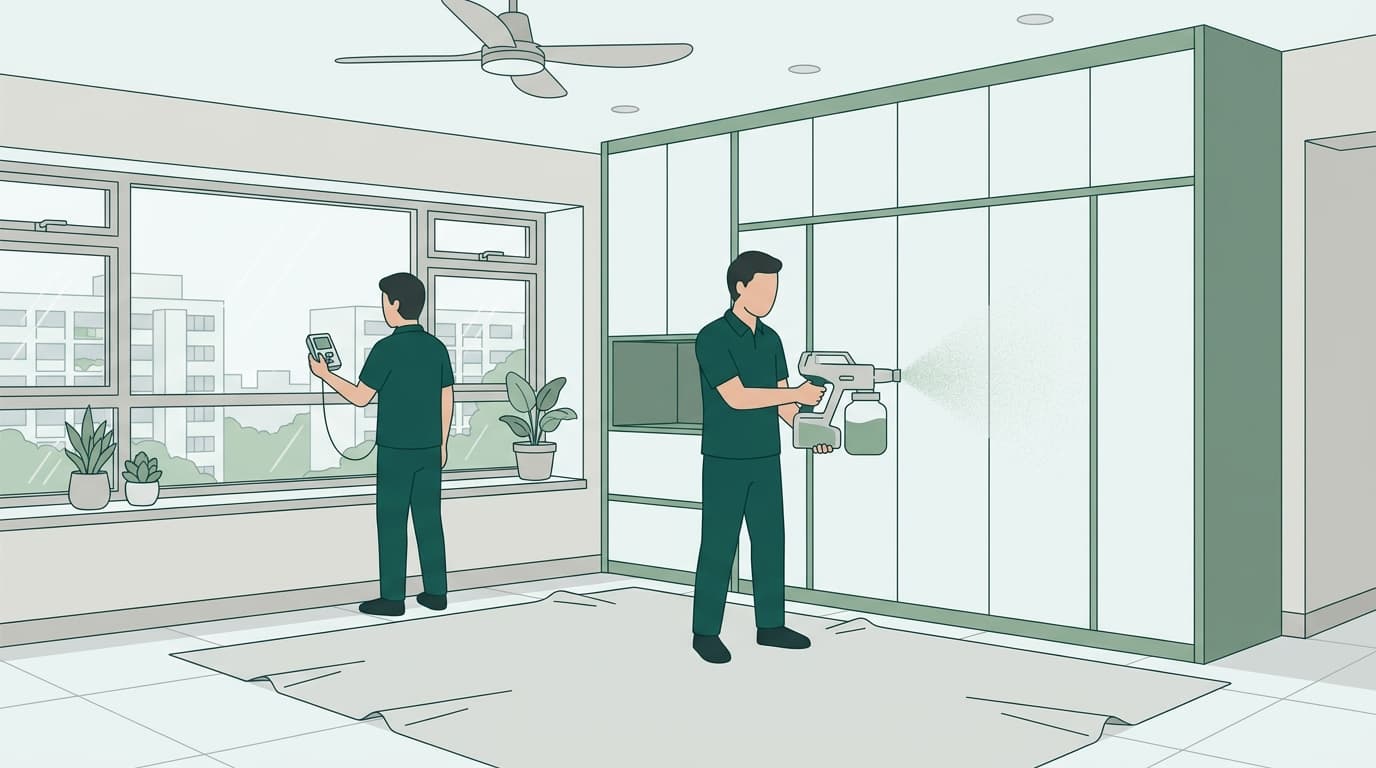
Our treatment works at the source. Technicians first cover appliances and anything not being treated with protection sheets, then apply two cycles of a water-based catalytic solution — tested and certified by SGS Singapore for efficacy and human safety — to carpentry, built-in and custom furniture, and painted walls. Drawers are taken out so their insides and the carcass behind them are treated too, not just the visible faces.
What the readings mean
Every visit starts and ends with room-by-room measurements on a calibrated professional meter — not the consumer handhelds sold online, whose sensors cross-react with alcohol and humidity. Readings are benchmarked against the WHO indoor guideline of 0.1 mg/m³, the same limit used by Singapore's SS 554 standard. A typical just-renovated bedroom reads 0.24mg/m³ before treatment; the after-target for every room is 0.06mg/m³ or lower, with the guideline as the line to get under.
Verification, in plain terms
Off-gassing does not stop the day we leave — treatment cuts the release rate. That is why the job ends with measurement, not reassurance: final readings are taken in every room in front of you, the report is yours to keep, and we return one week later to re-check the levels. Every treatment carries a 1-year service warranty, and a S$100 testing visit can re-verify any room after that. The benchmark is the meter reading, nothing subjective.
Fixed prices by home size
Year-end promotion — prices below valid for bookings until 31 Dec 2026
| Home | Price |
|---|---|
| HDB / BTO flats | |
| 2-room | |
| 3-room | |
| 4-room | |
| 5-room | |
| Executive apartment / maisonette | |
| Condominiums & ECs | |
| Up to 500 sqft | |
| 501–800 sqft | |
| 801–1,200 sqft | |
| 1,201–1,500 sqft | |
| 1,501–2,000 sqft | |
| Landed & larger homes | |
| Landed homes & penthouses | Quoted |
| Condo / EC over 2,000 sqft | Quoted |
No GST is added. No deposits, no on-the-day surprises. Condo prices are confirmed within the range before you book; quoted jobs are confirmed on WhatsApp.
- Initial formaldehyde reading in every room, before any treatment
- Protection sheets over appliances and anything not being treated
- Two cycles of SGS-certified catalytic solution on carpentry, custom furniture and painted walls, with drawers removed and treated
- Final readings on the day, with a written report benchmarked against the WHO 0.1 mg/m³ guideline
- Return visit one week later to re-check the levels
- 1-year service warranty
No surcharges — the price confirmed before you book is the full price. Landed homes, penthouses, homes over 2,000 sqft and commercial spaces are quoted per job. Full price list → How formaldehyde removal costs compare →
Questions about the service
What chemicals do you use, and are they safe?
We use a water-based catalytic solution that has been tested and certified by SGS Singapore for both efficacy and human safety, applied in two cycles. Appliances and anything not being treated are covered with protection sheets first. The home should be vacated during treatment and ventilated for 12–24 hours afterwards, after which it is safe for children, pregnant women and pets.
Why treat the source instead of using an air purifier?
Purifiers with activated carbon capture some airborne formaldehyde, but the source — resins inside your carpentry — keeps releasing it around the clock for years. Filters saturate and become ineffective, often without any indication. Source treatment breaks formaldehyde down where it is generated, which is why post-treatment readings stay down.
Does one treatment last, or will I need repeat visits?
One whole-home treatment is the norm. Off-gassing continues at a much-reduced rate after treatment, which is why we take final readings before we leave and come back a week later to re-check the levels. Every treatment also carries a 1-year service warranty. After that, a S$100 testing visit can re-verify any room whenever you want fresh numbers.
How do I get rid of formaldehyde quickly?
Professional source treatment is the only fast option: a 2–4 hour visit treats the source directly, with readings before and after and a re-check a week later. Everything else is slow — ventilation takes months to years to achieve the same result, and purifiers only manage levels while running. If you have a move-in date next week, treatment is the lever that actually moves it.
Can formaldehyde be removed permanently?
Yes, in the sense that matters: the catalytic solution breaks formaldehyde down at the surface layers of your carpentry, where it is released, so levels do not simply rebound when the windows close. Deep-bound resin continues to break down at a much-reduced rate for years — which is why we re-check a week later rather than promising a magic number of zero.
How should I prepare my home for treatment?
Open wardrobe doors and drawers, clear surfaces you want treated, and plan for everyone (including pets) to be out during the visit and for 12–24 hours of ventilation afterwards. We handle the rest, including moving light furniture back.
Get your fixed price on WhatsApp
Tell us your home type and renovation date — we confirm the price and a slot, usually within the same week.
We reply on WhatsApp within 15 minutes during opening hours.