
Guide · Updated July 2026
Low-formaldehyde plywood & carpentry boards: how to spec them
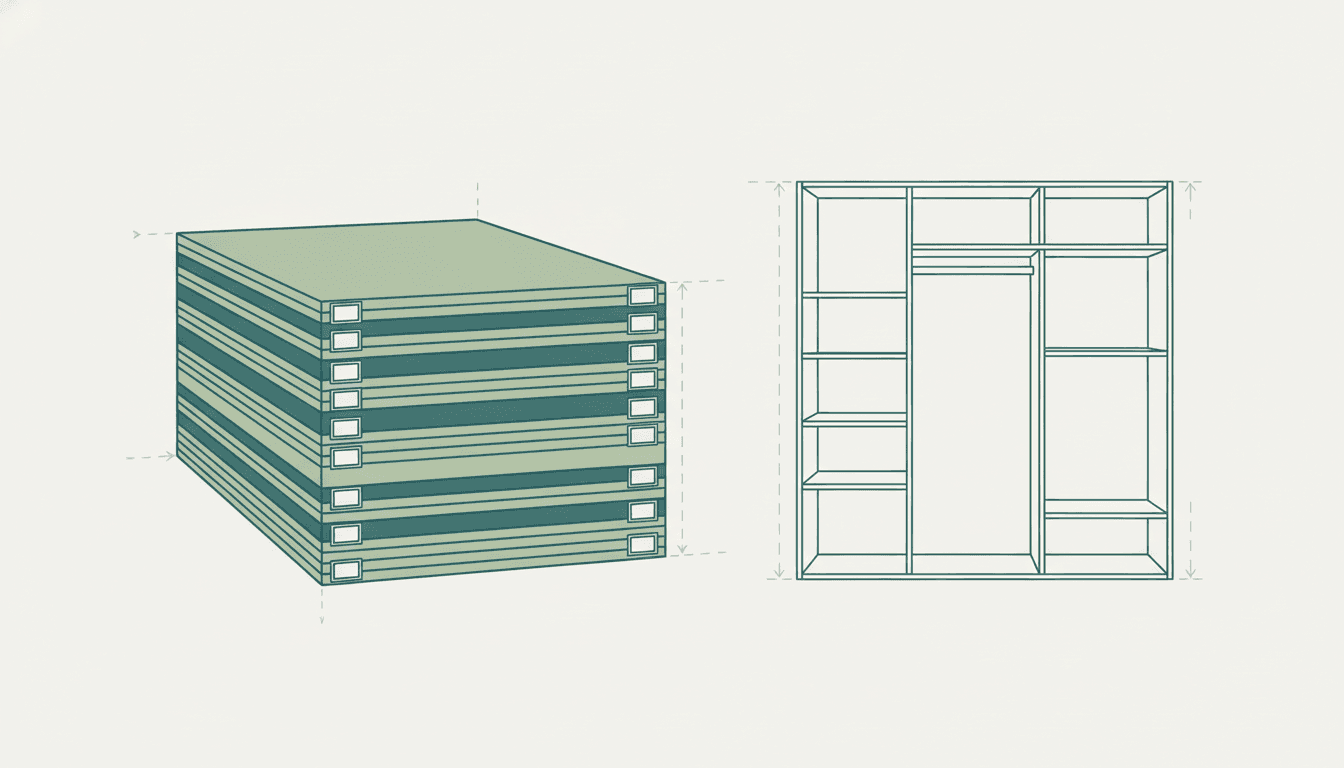
The cheapest formaldehyde treatment is the one you never need — and the only moment you can buy it is before the carpentry is built. Built-in wardrobes, kitchen carcasses and feature walls are the largest area of composite board in most Singapore homes, and unlike paint they keep emitting for years. The emission class your contractor quotes for those boards sets the baseline your home lives with. This guide covers what the classes actually cap, what the upgrade costs, and how to make it stick in a quotation.
Why carpentry matters more than furniture
A loose wardrobe you can return. Built-ins you cannot. In a typical 4-room HDB flat, fitted carpentry accounts for far more board area than every piece of loose furniture combined — wardrobes across two or three bedrooms, kitchen top and bottom carriers, a TV console, a study carrier, sometimes a full feature wall. Nearly all of it is plywood, MDF or particleboard bonded with formaldehyde-based resin, and much of it sits behind closed doors where the gas concentrates rather than disperses.
That is the difference worth internalising: emissions scale with enclosed board area, and carpentry is where the area is. If you are choosing loose furniture instead — Taobao flat-pack, IKEA, retail — the buying checks are different and covered in new furniture formaldehyde.
What the emission classes actually cap
Every class below is a limit on measured emissions under standardised test conditions, not a statement about the wood. None of them mean formaldehyde-free. They are directly comparable only within a standard, since each uses its own chamber method and units.
| Class | Standard | Limit |
|---|---|---|
| E1 | China GB/T 39600-2021 | ≤ 0.124 mg/m³ — the baseline most reputable suppliers meet |
| E0 | China GB/T 39600-2021 | ≤ 0.050 mg/m³ — roughly half of E1 |
| ENF | China GB/T 39600-2021 | ≤ 0.025 mg/m³ — the strictest Chinese class |
| CARB P2 / TSCA Title VI | US EPA | ≤ 0.05 ppm hardwood plywood, ≤ 0.09 ppm particleboard, ≤ 0.11 ppm MDF |
| F★★★★ | JIS (Japan) | ≤ 0.3 mg/L desiccator average — widely used on Japanese-origin panels |
A practical reading of that table: E1 is a floor, not an achievement. It is what a competent supplier should already be providing. The meaningful upgrade for a home you intend to move into quickly — or with a baby in it — is E0 or better on the boards that make up bedroom wardrobes.
Which boards to prioritise
Upgrading every board in the flat is rarely necessary or affordable. Emissions concentrate where board area is high and airflow is low, so spend the budget in this order:
- Bedroom wardrobes — the highest-value upgrade. Large enclosed volume, doors shut most of the day, and it is the room where occupants spend eight hours breathing.
- Children's and nursery carpentry — smaller bodies, higher breathing rate per kilogram of body weight. See formaldehyde, babies and pregnancy.
- Kitchen carcasses — large area, and heat from cooking raises emission rates.
- Open shelving and feature walls — lowest priority. Exposed surfaces in ventilated space release faster and clear faster.
What the upgrade costs
Board is one input among many in a carpentry quote — labour, hardware, laminate and finishing usually dominate. Moving from E1 to E0 on selected carcasses typically shifts the carpentry line by a modest percentage rather than transforming the budget, and quotes vary enough between contractors that you should ask for the delta explicitly: "quote this as specified, then quote the same job with E0 carcasses for the bedroom wardrobes." Two numbers side by side is the only honest way to see what you are being charged for the upgrade.
For comparison, treating the same carpentry after the fact starts at S$420 for a whole home at our published prices. Specifying better board is usually the cheaper end of that comparison — but the two are not substitutes, for the reason in the next section.
How to make it stick in the quotation
Verbal agreement is worthless here, because you cannot inspect the result. Grade stamps are printed on board faces and edges, and fabrication cuts away or laminates over almost all of them. By handover there is usually nothing left to check.
- Write the class into the quote line itself — "18mm E0 plywood carcass", not "quality plywood". A specification that is not in writing is not a specification.
- Ask for the mill test certificate at delivery, naming the standard (GB/T 39600, CARB P2, JIS). Suppliers with genuine certification produce it readily; hesitation is itself an answer.
- Photograph the board edges on site before fabrication, while the stamps are still visible.
- Be specific about scope. "E0 carpentry" often means the carcass only — backing boards, drawer bases and edge banding may be a different grade. Ask which parts are covered.
The honest limit of specifying well
Emission classes are measured per board, in a ventilated laboratory chamber. Your home is the opposite: many boards at once, in a sealed, air-conditioned flat, in a climate that runs warm and humid — and both heat and humidity increase the rate at which resin releases formaldehyde. A flat built entirely from compliant boards can still sum above the WHO indoor guideline of 0.1 mg/m³ once the doors and windows close.
This is not an argument against specifying well — a lower starting point is genuinely a lower ending point. It is an argument against treating the label as proof. The class tells you what you bought; a reading tells you what you are breathing. What the numbers mean is covered in safe formaldehyde levels.
Common questions
Is low-formaldehyde plywood worth the extra cost?
For built-in carpentry, usually yes. Carpentry is the largest board area in a typical Singapore home and it emits for years, so the grade you specify sets your baseline for the life of the renovation. Upgrading the boards used for wardrobes and kitchen carriers is a small percentage of a carpentry budget and is far cheaper than treating the same surfaces later.
What is the difference between E0 and E1 plywood?
Both are emission limits measured under standardised chamber conditions, not descriptions of the wood itself. Under China GB/T 39600-2021, E1 caps emissions at 0.124 mg/m3 and E0 at 0.050 mg/m3 — roughly half. A third class, ENF, caps at 0.025 mg/m3. E0 boards are not formaldehyde-free; they emit less per board.
Can I tell what grade my contractor used just by looking?
Rarely. Grade markings are printed on the board face or edge and are usually cut away or covered by laminate during fabrication. This is why the grade needs to be written into the quotation before work starts, with the mill test certificate requested at delivery — after installation, an air-quality reading is the only practical check.
Does using E0 boards mean I will not need formaldehyde treatment?
Not automatically. Emission classes are measured per board in a lab, while your home sums the emissions of every board in an enclosed, air-conditioned space. A flat lined entirely with compliant carpentry can still read above the WHO 0.1 mg/m3 guideline. Specifying better boards lowers the starting point; a reading tells you where you actually landed.
Renovation already done?
If the carpentry is built and you are wondering where it landed, a S$180 testing visit gives you room-by-room readings — so you decide based on your home's actual numbers rather than the grade you hope you got.