

Guide · Updated September 2026
New renovation smell: what off-gasses and for how long
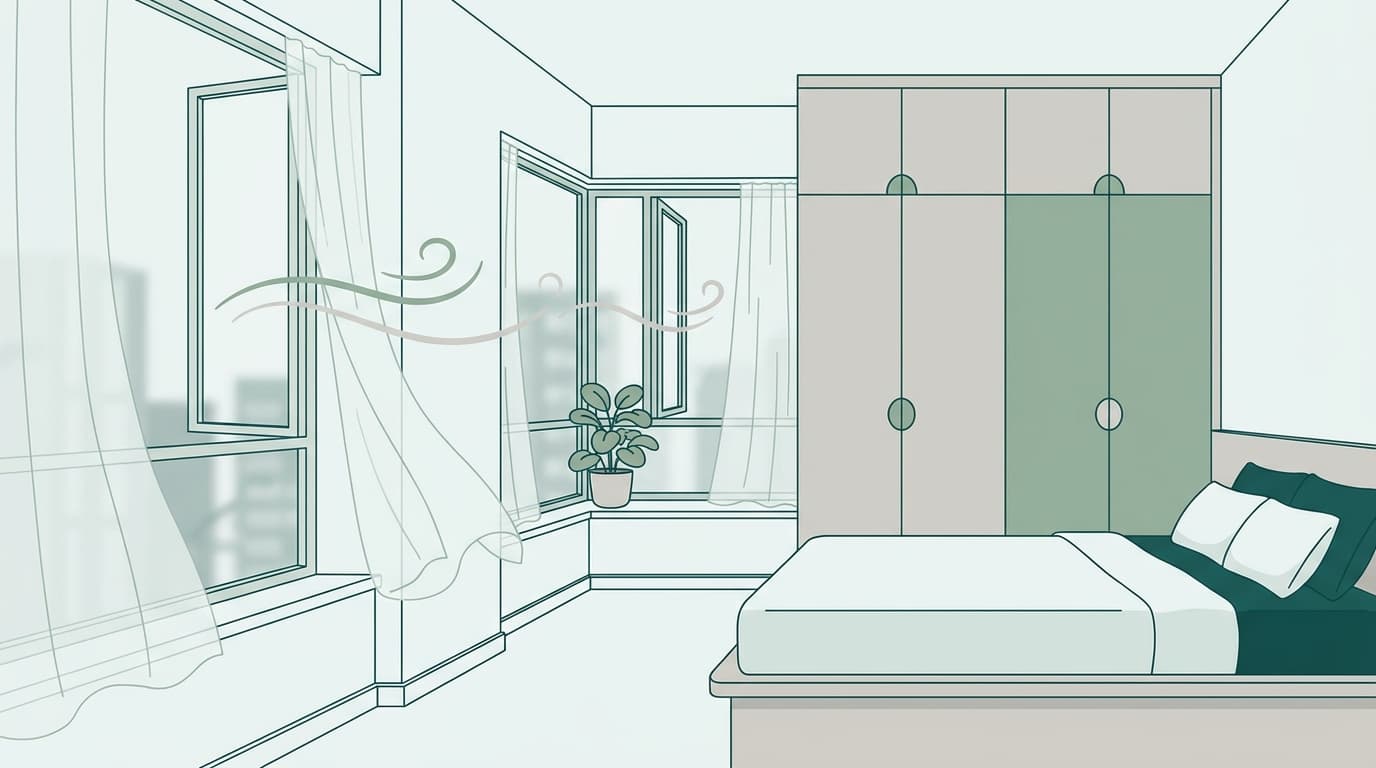
The "new renovation smell" is a cocktail: solvents and VOCs from paint and adhesives that dissipate over days to weeks, plus formaldehyde from carpentry resins, which off-gasses for years. Most of what you can smell fades quickly. The catch is that the longest-lasting, health-relevant component — formaldehyde — is largely odourless at the concentrations that matter, so a home that smells fine can still read above the WHO guideline of 0.1 mg/m³.
What's actually in the smell
| Source | Compound class | Typical dissipation |
|---|---|---|
| Fresh paint | Solvents / VOCs | Days to weeks |
| Adhesives & sealants | VOCs | Weeks |
| New carpentry (plywood, MDF, particleboard) | Formaldehyde from urea-formaldehyde resin | Months to years (studies measure 3–15 years) |
| New sofas, mattresses & curtains | Mixed VOCs + formaldehyde | Weeks to months |
The sharp, solventy edge of a fresh renovation is mostly paint and adhesive VOCs — unpleasant, but transient. Formaldehyde behaves differently because it isn't a coating that dries out: it is manufactured into the urea-formaldehyde resins that hold plywood, MDF and particleboard together, and it releases continuously as those resins slowly break down. (For the fuller chemistry, see VOC vs formaldehyde: what's the difference.)
Why Singapore makes it worse
Urea-formaldehyde resins break down through hydrolysis — a reaction driven by exactly the two things Singapore has in abundance: heat and humidity. The same wardrobe that would off-gas slowly in a temperate climate releases formaldehyde noticeably faster here, and the effect persists for as long as the resin lasts. It is the main reason formaldehyde removal in Singapore is usually a treatment question rather than a waiting game.
Living habits compound it. Most renovated homes here are closed up with the aircon running, which recirculates indoor air rather than replacing it. The counterintuitive result: a cooled, closed bedroom a month after handover can measure higher than the same room did with the windows open during the renovation itself. Off-gassing didn't stop when the contractors left — the ventilation did. A post-renovation cleaning at handover clears the dust and adhesive residue, but not the formaldehyde inside the boards — that has to be measured on its own.
What actually shortens the timeline
Honestly ranked, from what the evidence supports:
- Source treatment — decomposition agents applied directly to carpentry break formaldehyde down where it is released, which is why it works in hours rather than years, and why results can be verified on a meter the same day. This is what our formaldehyde removal service does.
- Ventilation, with heat — the traditional "bake-out": close the home to let heat build, then flush thoroughly with open windows, repeated over weeks. It genuinely helps, and it's free — but it is slow, labour-intensive, and levels rebound whenever the home returns to closed-up, aircon-cooled living.
- Air purifiers with activated carbon — capture some airborne formaldehyde but never touch the source. Useful as an adjunct; the carbon saturates silently and needs regular replacement to keep doing anything at all.
- Plants, charcoal bags, pandan leaves, onions — the removal rates measured for these are negligible against a whole home's worth of emitting carpentry. They make the air smell nicer, which is precisely the problem: they treat the smell, not the gas.
When the smell is gone but the problem isn't
Two things conspire to make your nose a poor instrument. First, olfactory fatigue: live with a smell for a week or two and your brain stops reporting it, even at unchanged concentrations — which is why visitors notice your "new reno smell" after you've stopped. Second, formaldehyde's odour threshold sits near or above the levels that matter for long-term exposure, so a room hovering around the guideline may not smell like anything at all.
The only way to know is to measure. A formaldehyde testing visit (S$100) gives you room-by-room readings against the WHO guideline — and safe formaldehyde levels explains what the numbers mean once you have them.
Just finished a renovation?
Fixed treatment prices are on the price list — or book in under a minute.