

Guide · Updated September 2026
How to remove formaldehyde: what works and what doesn't
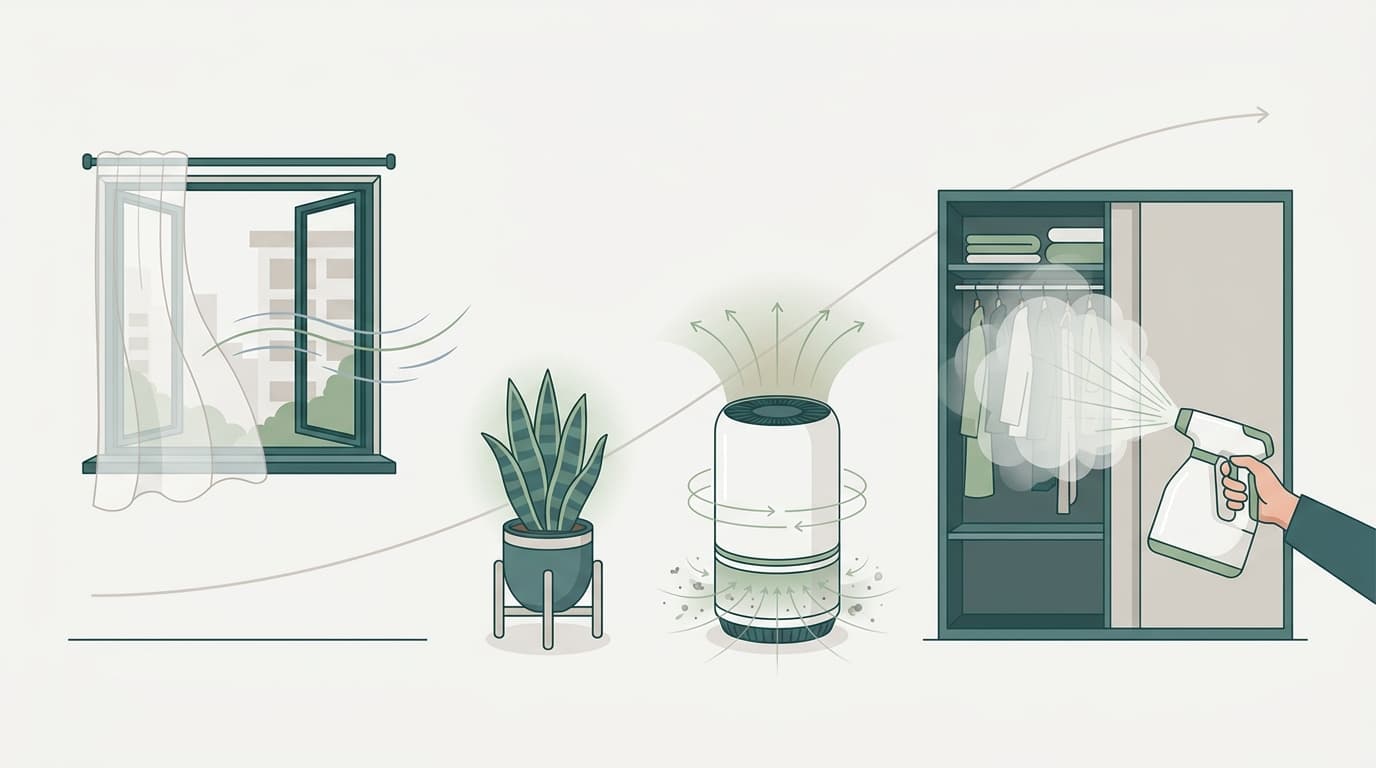
There are only two real ways to deal with formaldehyde in a home: wait out years of natural off-gassing while managing the levels, or decompose it at the source. Everything sold or suggested for formaldehyde removal falls into one of those camps, and most of the popular options do far less than their marketing implies. Below is every common method, ranked honestly — including the ones we don't sell.
Every method, with an honest verdict
Ventilation (open windows, fans)
Verdict: genuinely helps, free — but slow, and it rebounds. Moving air out of the house removes the formaldehyde already released, and it is the first thing every household should do. What it cannot do is reach the urea-formaldehyde resin sealed inside your carpentry, which keeps generating more. Levels drop while windows are open and climb back whenever the home is closed up with the aircon running — which in Singapore is most of the time. Expect months to years to reach consistently safe readings by ventilation alone.
Bake-out (heat plus ventilation)
Verdict: works marginally, with real downsides. Heating a closed home accelerates off-gassing, then airing it out flushes the released gas — repeated over days or weeks. The physics is sound, but the acceleration is modest at temperatures a home can safely reach, and sustained heat can warp laminates, dry out carpentry finishes and stress sealants. It is a weeks-long project that shortens the tail somewhat, not a fix.
Activated-carbon air purifiers
Verdict: manages levels while running — does not remove the source. A purifier with a substantial carbon filter captures part of the airborne formaldehyde passing through it. The source keeps emitting around the clock, the filter saturates silently (often within months), and protection stops the moment it is saturated or switched off. Useful as an adjunct in a bedroom; not a removal method. We cover this in detail in do air purifiers remove formaldehyde.
Plants, charcoal bags, onions, vinegar
Verdict: negligible. Houseplants absorb formaldehyde at rates so low that a flat would need hundreds of them to matter. Bamboo-charcoal bags adsorb a tiny amount and re-release it as they saturate. Onions and vinegar only mask odour — they remove nothing. These remedies persist because formaldehyde's smell fades on its own over weeks, and whatever was nearby gets the credit.
DIY formaldehyde-removal sprays
Verdict: surface-level and short-lived. Consumer sprays use diluted versions of real decomposition chemistry, but a light hand-mist treats only the outermost surface, misses enclosed high-emission areas like wardrobe interiors and board edges, and — without a calibrated meter — gives you no way to know whether it worked. Most homes that try them still read elevated afterwards. There are narrow cases where a bottle is the right call: formaldehyde removal sprays, in full covers what is in them and when they are worth using.
Professional source treatment
Verdict: the only fast, verified option. Technicians spray a professional catalytic solution directly onto carpentry, board edges, drawer and wardrobe interiors and painted walls — the actual emission points — then measure every room against the WHO and SS 554 guideline of 0.1 mg/m³ (0.08 ppm). A whole home takes 2–4 hours and costs from S$280 at published fixed prices (see what formaldehyde removal costs in Singapore for how that compares across the market). Details of the treatment and warranty are on our formaldehyde removal service page.
How do I get rid of formaldehyde quickly?
Professional source treatment is the only method measured in days rather than months: a 2–4 hour visit plus 12–24 hours of ventilation, with readings before and after and a re-check a week later. If you have a move-in date next week, no amount of plants, purifiers or airing out changes the timeline the way treatment does.
Can formaldehyde be removed permanently?
Yes, in the sense that matters. Treatment breaks down the formaldehyde in the surface layers of your carpentry, where it is released. Deep-bound resin continues to break down at a much-reduced rate for years — which is why a credible service verifies with readings rather than promising an impossible zero. Ours is simple: every room is read in front of you before we leave, we come back a week later to re-check, and the report is yours to keep.
How to remove formaldehyde after renovation in Singapore
Singapore's heat and humidity continuously hydrolyse the resins in new carpentry, so off-gassing here runs faster and longer than in temperate climates — and closed-up, air-conditioned rooms concentrate it. The practical sequence: ventilate daily from handover, then either book formaldehyde removal before move-in (the standard play when the smell is obvious) or spend S$100 on a room-by-room formaldehyde test and let the numbers decide. What the readings mean is covered in safe formaldehyde levels.
Want it gone this week, not next year?
Fixed prices by home size are on the price list, or book a visit in under a minute.